 |
| Lack of focus* *All photos in this post have been used without permission; I Googled each of them. You may click any image to enlarge it. |


- Student Safety
- Student Achievement
- Student Development
When it comes to our focus (foci) at Marshall, I think we've got Student Safety pretty much down, especially after last year. And I don't think anyone will begrudge us in our efforts to continually practice and refine our procedures this year after all that we've endured.
I also think we've got Student Achievement pretty-much in-hand, too, though it's become quite challenging for us to gauge this component using the means we've employed in the past. With AZLEARNS letter grades gone for now, and AZMERIT scores still somewhere out there in the ether, we've got only the benchmarks and assessments that we've used in-house: Galileo and AIMSWEB, and, well, they look pretty good. Room to grow, as always, for sure. But pretty good, all in all.
And I think we've got Student Development in the bag, too. Most of us have solid class-management plans in-place and likewise most of us are implementing our Tier 1 and 2 PBIS program effectively. Our grade level teams are putting our IDM, GDM, and B-GDM processes to work exceptionally well, too. Marshall's counseling and school-psych team is always ready to assist us, even at a moment's notice. And, in general, our aides and parapros get sharper and better equipped to provide much-needed support to our students, especially the ones who stick around year after year.

All in all, when it comes to focusing on the-obvious-things-right-in-front-of-us, I'm inclined to observe: we've got this.
Sometimes, however, a keen but unexpected focus can yield surprisingly beautiful, if not downright inspiring results.


(Please note: I am in no way suggesting that we stop focusing on the things right in front of us. We can't ever do that! Those things, well, that's basically our job in a nutshell, isn't it: keep 'em safe, teach 'em some stuff, and, oh yeah, get 'em all grow'd up nice, too. But, we have before us, I think, an opportunity this school-year to focus on a couple less-obvious things which might "yield surprisingly beautiful, if not downright inspiring results," too.)
Interested? Ok then.
Not to get all science-y on you now, but if you think back to your high school physics class, you'll probably remember that a camera lens technically has two focal points... a point in front of the camera (there be your subject) and a point within the camera (where your image is magically in focus). There must be parity or agreement between these two points for your image to be sharp, elsewise, if your focal distance isn't balanced, your image will blur and become something less than the masterpiece it (let's be honest) demands to be.


Having said all that, it should come as no surprise that I'd like to encourage you to shift your focus somewhat this year, to attend your professional-gaze to two separate concerns which might not be super-obvious or right in front of us all the time, to literally physically reorient your professional-self to do new things in new ways. I think, if we try to focus on these things, we have the potential to make Marshall all-the-more exceptional, proficient, and refined in the ways we think and act both towards our students and toward one another.
Focus 1: Grading & Assessment
Hopefully you attended the 301 Day on Monday 03 Aug. and listened carefully to what Thomas Guskey had to say. Hopefully, you received a copy of his book, On Your Mark.

Hopefully you will read it.
I have. I read it last year as a part of a book study with the other elementary principals in FUSD. It affirmed many of my notions about what, and how, and why we assess student learning as well as the fact that we, as a district, need to reexamine and refine our practices when it comes to the assessment of learning.
We're a bit ahead of the curve here at Marshall. But only a bit. We've already begun to reflect on grading and assessment. You might recall, last school-year, in January in the Blue Note, I asked you to complete a formal survey about your thoughts and beliefs in this regard. The results were encouraging and seem to suggest that many, if not the majority of you, tend to hold fairly progressive views about standards-based grading and assessment. The survey also demonstrated that most of you seem to feel that our current methods, which while conforming to our district's expectations, may not be the best way for our students and their parents to truly understand Student Achievement based on mastery of the standards.
I'd like us to focus on standards-based grading and assessment this year. I'd like our grade-level teams to experiment with developing new forms for assessment in an attempt to devise more valid and reliable ways to determine what our students actually know and, likewise, what they are able to do. I'd like us to perhaps even come up with new tools and means to communicate these outcomes to both our students and their parents.
How do we accomplish all that? We experiment. We take chances. We open ourselves to change. Rick Wormeli, another grading/assessment-guru, has a few good suggestions about one small aspect in our approach to all this that we might consider changing: our grade-books:
As Marshall teachers, if we choose to take on this new focus, I think we may have a chance to lead change in this regard, throughout FUSD in a very positive direction. That's never easy. But it's often exciting. It's usually important, too. As Guskey says,

Focus 2: Support & Well-being
Some months ago, as is their habit, the powers-that-be at FUSD sent out their annual link to an employee satisfaction survey. This year, for the first time, the survey was nationally norm-referenced and the questions pertained not just to Marshall, and not just to certified staff, but to administrators and classified staff across the district, too. More than 700 of the district's employees filled out the survey. At Marshall, of some 70 people who work here, about 30 completed the twenty-five question inventory.
At Marshall, in the main, based on this survey it looks as if we are satisfied with much of our workplace environment; our relationships with our coworkers as well as with our supervisor(s) all came out well above the national norms set for these indicators. Similarly, morale, teamwork, and how/when/where we enjoy a little recognition for the work we do all came out well above national norms, too.
However, at Marshall (and consequently across FUSD), support is one of the indicators that came out the lowest. At our school, it's the only one that's below the national midrange (just a hair, the 49th percentile, to be exact), which is concerning to me (particularly when compared to many of our other scores which were in the 60th and 70th percentile nationally).
It's hard for me to glean fully from your responses where this sense of a lack of support derives from. But, reading through your comments, a couple of you said things like:
"Resources are limited [and] we hear, there's no money for that..."
"Ask the teachers what kind of resources we need..."
In response to those comments, I'd like to encourage you, once again, to let me know what you need and when you need it. Our coffers at Marshall are not bottomless, but they are not empty either. We work awful hard around here to raise, chase, gather, and collect money. So, if you have a need and you're able to justify that it will be of great benefit to your students, please make your requests known. I may say, "Please try and find a better price," or, "Please find a way to better align your request with the standards." I might even ask, "Is it urgent? Can you wait until we receive our new budget monies?" But when it comes to the expenditure of our tax credit donations, our dodgeball funds, or the monetary gifts that have been given to our school, I (often by proxy of the Site Council) rarely (if ever) just say no.
Many more of you provided comments on the survey related to support that went more like this:
"FUSD needs to provide adequate special services assistance...
"...provide resources to inclusion students..."
"More, qualified SPED aides..."
"...the lack of special education services..."
"...parapros need to be trained..."
"We absolutely need more support for special education..."
To which I can only reply, "I know." We've tried to offset this need for this school year by hiring one of our own faithful faculty members, Laura Alonso-Paez, into a new support-services position to fuction as our multi-tiered systems of support specialist, to oversee the implementation of our SPED inclusion, talented-and-gifted, and cross-categorical programs at Marshall. Plus, we retained our now seasoned-veteran SPED Resource teacher, Amanda Fugett, recruited another excellent and well-recommended SPED Resource teacher, Kaitlin Sally-Trulock, and been able to convince the vast majority of our experienced paras to stick around. And finally, I want you to know, I've spent my summer doing pretty much just one thing: trying to hire the best and most well-qualified paraprofessionals FUSD's money can buy.
Together, this team and I will do all that we are able to do to support you and the exceptional students on both ends of the spectrum in your classroom.
Also pertaining to support, on the survey a few of you also mentioned things like:
"...improve the morale of staff..."
"...coworkers try to support one another..."
"...most of the staff are willing to help one another..."
"...there is strong collaboration between faculty..."
"I have felt cared about, loved, and appreciated so much this year..."
To respond to these statements, I have reworked our school committees, eliminating some, combining others, and, most importantly, revamping our long-standing Social Committee into a Faculty Engagement Committee whose new job description reads,
"Recognizes staff bereavements, birthdays, anniversaries, and other achievements, plans and coordinate occasional/seasonal celebrations and staff gatherings to encourage staff to engage with one another on a social basis. Creates calendar of events, coordinates event workforce. Attendance at after-school events may be required. Meets monthly at a time to be determined by the committee."
It is my hope that this group will actively take on the job of helping all of us to support one another.
We're all in this together, after all.
Finally, I also want you to encourage you to support yourself this year. I want you to focus for the next 10 months on your own well-being and how you might better balance your work-life with your not-work-life.
Did you know that in 2008 the federal Bureau of Labor and Statistics found out that teachers...
- are more likely than any other group of professionals to do work at home
- are more likely than any other group of professionals to go in to work on Sunday
- are more likely than any other group of professionals to have more than one job
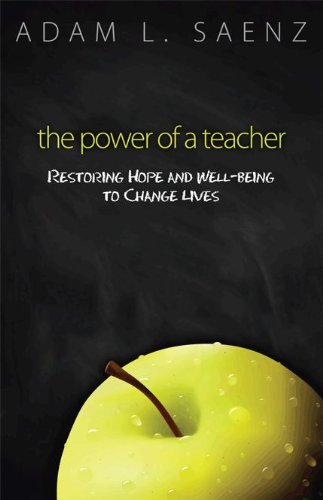
I was given a free copy of his book at the conference, The Power of a Teacher, and read it the next week with great interest. It's quite good and contains a number of strategies and encouragements to help the reader strive for balance and achieve greater personal well-being in life. I would be happy to loan it out.
Before we conclude our time together today, I'd like us to watch the first 28 minutes of his talk:
